How Grind Consistency Affects Your Vaporizer Performance

Fordee
March 18, 2026
The Most Overlooked Variable
Ask any vaporizer user what matters most for a good session and you'll hear about temperature, draw speed, and packing technique. All of those are important. But there's a variable that sits upstream of all of them, quietly shaping every session you have: your grind consistency.
The way you grind your material determines how air flows through the chamber, how much surface area is exposed to heat, and how evenly extraction happens across the bowl. Get it wrong and you'll fight your device the entire session. Uneven heating, poor flavor, weak clouds, or material that's charred on one side and green on the other.
Get it right and everything else falls into place.
Why Grind Matters: The Physics
Vaporization is about heat transfer, and grind consistency controls two things that determine how well that happens:
Surface area. Finer grinds expose more surface area to heat, meaning faster extraction and thicker vapor at lower temperatures. Coarser grinds slow extraction and can require higher temperatures for the same vapor density.
Airflow. The spaces between ground particles create the air channels that carry heat through the chamber. Too fine, and those channels collapse. Airflow is restricted and your device works harder. Too coarse, and air rushes through gaps without picking up much vapor.
The ideal grind balances surface area and airflow. But that ideal depends on your heating method.
Conduction Vaporizers: Go Fine
Conduction vaporizers heat your material through direct contact with hot surfaces, usually the walls and floor of a ceramic or stainless steel chamber. The more material that touches those surfaces, the more efficiently it extracts.
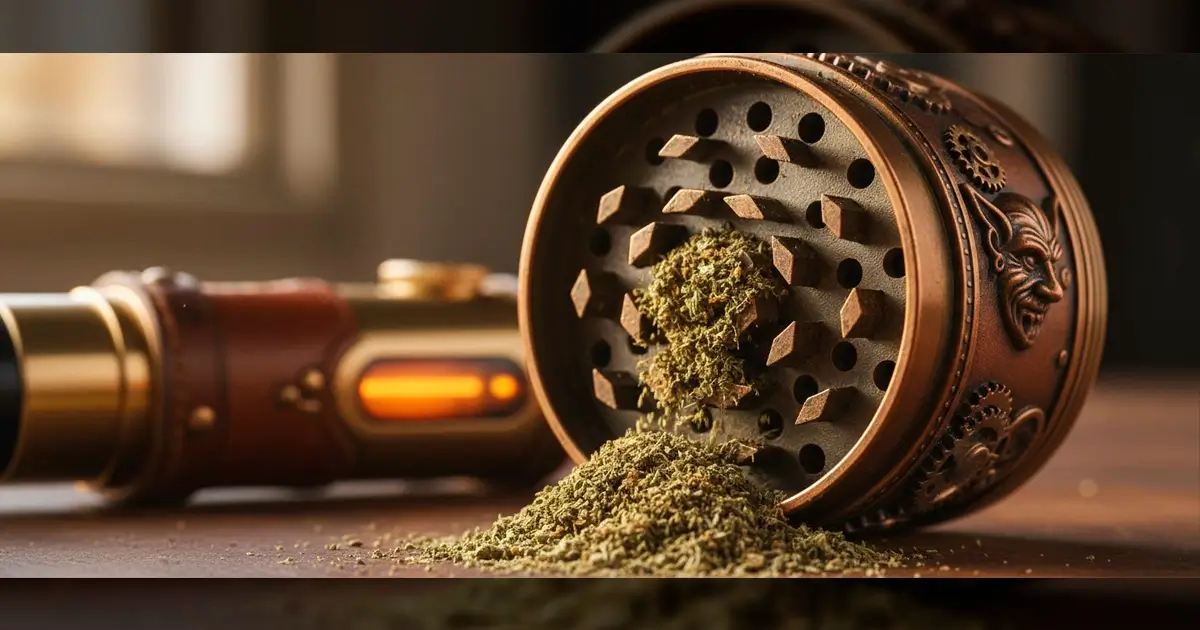
A fine, consistent grind is best for conduction devices. Think table salt or finely ground coffee. You want to maximize contact with the chamber walls.
With a fine grind in a conduction vape:
- More material contacts the heated surfaces directly
- Extraction starts faster and produces vapor more quickly
- Sessions are more consistent from first draw to last
The trade-off is that fine grinds can restrict airflow in tightly packed chambers. Pack firmly but not too tightly. Snug against the walls without compressing into a solid plug.
Common conduction devices: XMAX Starry V4, DaVinci MIQRO-C, Flowermate V5 Nano
Convection Vaporizers: Go Medium
Convection vaporizers work differently. Instead of heating material through contact, they pass hot air through the chamber. The air itself is the heating element, and it needs room to flow.
A medium grind works best for convection devices. The particles should be roughly the consistency of dried oregano or coarsely ground pepper. This gives you enough surface area for efficient extraction while maintaining the air channels that convection heating depends on.
With a medium grind in a convection vape:
- Hot air flows freely through the material
- Extraction is even across the entire bowl, not just where material touches the walls
- Flavor is cleaner because the air doesn't get choked through overly dense material
- Draw resistance stays comfortable. You don't have to pull hard.
If you grind too fine for a convection device, you'll pack the chamber too densely and block the airflow that the heating system relies on. The result is restricted draws, uneven heating, and frustration.
Common convection devices: Arizer Solo 2, XMAX V3 Pro, Wolkenkraft FX Mini, Arizer V-Tower
Hybrid Vaporizers: Adjust to Taste
Hybrid vaporizers use both conduction and convection heating. These are the most flexible when it comes to grind. You can lean fine or medium depending on which heating element you want to emphasize.
As a starting point, aim for a medium-fine grind with hybrids. This gives the conduction surfaces enough contact while still allowing airflow for the convection component. From there, experiment:
- If you want thicker vapor and don't mind slightly more draw resistance, go finer
- If you want smoother airflow and more flavor clarity, go slightly coarser
Devices like the DynaVap M7 and Boundless CF fall into this category, and they're forgiving enough to work well across a range of grind sizes.
Signs Your Grind Is Wrong
Not sure if your grind is causing issues? Here are the telltale signs:
Too fine:
- Draw resistance is noticeably high. You have to pull hard.
- Material is dark or charred near the chamber walls but still green in the center
- Sessions feel "stuck" and airflow drops as the session progresses
- Your device's temperature seems to climb but vapor production doesn't match
Too coarse:
- Vapor is thin and wispy even at higher temperatures
- Material looks unevenly extracted after a session, some dark, some light
- Flavor fades quickly despite material remaining in the chamber
- You feel like you need to pack significantly more material than usual
Just right:
- Draw resistance is comfortable and consistent throughout the session
- Material extracts evenly. Uniform color after a full session.
- Vapor production matches your temperature setting predictably
- Flavor develops naturally from terpene-forward to deeper notes as the session progresses
Grinder Recommendations
Your grinder is just as important as how you use it. Here's what to look for:
For fine grinds (conduction devices): A 4-piece metal grinder with sharp teeth. Grind upside down for 10-15 seconds before flipping right-side up. This keeps material in contact with the teeth longer for a finer result.
For medium grinds (convection devices): A 2-piece grinder or a 4-piece with just a few quick turns. Break up the material without pulverizing it.
For either: Avoid plastic grinders. Aluminum or stainless steel with sharp teeth produces the most consistent results. Expect to spend $15-30 on a grinder that will serve you for years.

“A dull grinder is worse than no grinder at all. If your teeth are worn smooth, it's time for an upgrade.”
How to Experiment Systematically
Knowing the guidelines is a start, but every material is different, and personal preferences matter. Here's how to figure out what works best for your specific setup:
- Pick one variable. Change your grind consistency but keep everything else the same. Same temperature, same packing density, same draw speed.
- Try three grinds. Do one session with a fine grind, one medium, and one coarse. Note the differences in flavor, vapor density, draw resistance, and how evenly the material extracts.
- Track your results. This is where having a system for session notes pays off. VapeHeatLab's Lab Notes feature lets you log your grind type alongside temperature, effects, and other session details. Over time, you build a clear picture of what works for each device and material combination.
- Check community profiles. When browsing heat profiles on VapeHeatLab, look for profiles that mention grind size in their descriptions. The best community profiles include this detail because experienced users know it matters.
The Compound Effect
Grind consistency isn't glamorous, but it's one of those foundational variables that makes everything else work better. The right grind at the right temperature for the right device creates a compound effect, each element amplifying the others.
If you've been using the same grind for every device you own, you're likely leaving good vapor on the table. Try adjusting for your device's heating method and track the results. The difference is often more dramatic than changing your temperature by 20 degrees.
Start with the grind.